 |
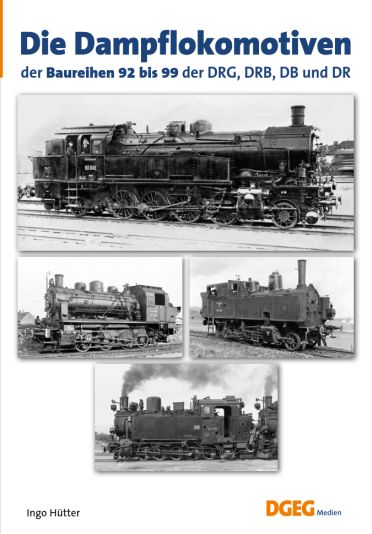
Ingo Hütter Die Dampflokomotiven der Baureihen 92 bis 99 der DRG, DRB, DB und DR DGEG Medien, 2026 ISBN 978-3-946594-37-6 |
The book series “Locomotives of German Railways – A Directory of All German Traction Vehicles” is aimed specifically at railway enthusiasts seeking the most important information about a locomotive’s history in a concise, comprehensive and complete format. The first five volumes cover the steam locomotives of the Deutsche Reichsbahn (following the introduction of the new numbering scheme in 1925), the Deutsche Bundesbahn and the Deutsche Reichsbahn of the GDR; further volumes on other railways will follow. Included are all vehicles designated according to the Reichsbahn numbering scheme, whether newly built or acquired from other railways. Most of the locomotives originate from the so-called ‘Länderbahnen’ (i.e. the Prussian State Railway or the Royal Saxon State Railway). However, locomotives taken over from private railways (e.g. the Brunswick State Railway, the Lübeck-Büchen Railway, the Oldenburg District Railway, Bremen Port Railway, Mecklenburg Friedrich-Wilhelm Railway, Lausitz Railway AG or Lokalbahn Aktien-Gesellschaft) are documented, as are the locomotives taken over during the Second World War from foreign state railways (e.g. from Austria, Czechoslovakia, Lithuania, Latvia, Poland, Belgium, Yugoslavia, Luxembourg). Also described in detail are the locomotives of the private railways nationalised in the GDR in 1950, which were assigned to almost all the series covered in this book. In addition to the vehicle lists, which detail the history of each locomotive including all changes of ownership and re-registrations, there is a brief description of each series with the most important technical data, as well as photographs showing the vehicles in profile. This fifth volume in the series is devoted to the tank locomotives of classes 92 to 99: Classes 92 to 96 were used for freight tank locomotives, though there were also numerous locomotives among them that were used to haul passenger trains. Class 97 was reserved for rack-and-pinion locomotives, and Class 98 comprised so-called ‘local railway locomotives’ (mostly of Bavarian origin). The final class, Class 99, included all narrow-gauge steam locomotives, with the sub-classes organised according to track gauge.
"Nobody is perfect" - also for this book some corrections are available.
The book can be orderer at the book shops, but also online, e.g. at: